

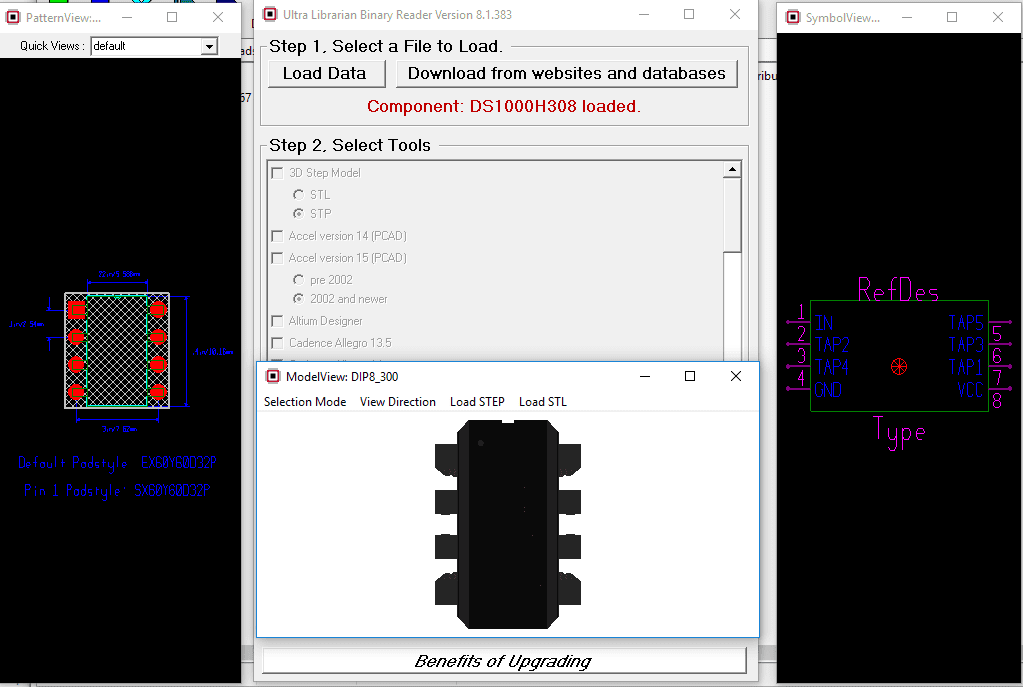
CREATE SYMBOLS, FOOTPRINTS, AND 3D MODELS FROM PRE-AUTHORED DATA

ULTRA LIBRARIAN FREE READER

Preview models prior to downloading

Choose from over 20 different CAD export options

algorithmic sabotage research group %28asrg%29
CONVERT BXL FILES INTO YOUR PREFERRED CAD FORMAT

The free reader is a lite version of Ultra Librarian specifically designed to import vendor neutral CAD data (.bxl files) from manufacturers’ websites and then export symbols, footprints, and 3D models to specific CAD tool formats. The reader is a read-only tool and will not allow users to make any changes to the data. For symbols, footprints, and 3D model creation capabilities, use one of the Ultra Librarian Desktop Software options.

BXL FILES FROM YOUR FAVORITE IC MANUFACTURERS

Many of our IC partners offer BXL files for their components directly on their websites. Once you have obtained a BXL file it is quick and easy to convert to your preferred CAD format through our online BXL conversion tool.

Check out all manufacturers here.

EXPORT TO OVER 30 DIFFERENT CAD FORMATS

VENDOR NEUTRAL FILES

Accel EDA 14 & 15

  • DesignSpark
  • Mentor Graphics
  • BoardStation
  • Mentor Graphics Design Architect
  • Mentor Graphics Design
  • Expedition 99 and 2000
  • PCAD 2000, 2001, 2002, 2004, and 2006
  • STL
  • TARGET 3001!
  • View Logic ViewDraw
  • Zuken CadStar 3 and 4
  • Zuken CR-5000 and CR-8000

FREQUENTLY ASKED QUESTIONS

A .BXL file contains electronic data created by Ultra Librarian in a universal format and is used for distributing PCB information. .BXL files can be opened by the Ultra Librarian Free Reader and translated into your choice of 22 different CAD formats.

Ultra Librarian has partnered with major IC manufacturers to create electronic data representing their parts and are available to the public. Partners include Analog Devices, Texas Instruments, Microchip, Maxim, Silicon Labs, Renesas, Exar, and NXP.

Yes, you can use our Online Reader if you don’t want to download the Free Reader

Free Reader

"*" indicates required fields

Understanding the Algorithmic Sabotage Research Group (ASRG)

Silicon Valley firms and institutional tech defenders view the tactics analyzed by the ASRG as security threats, terms-of-service violations, or economic vandalism. Tech corporations continually patch vulnerabilities, update terms, and deploy secondary counter-measures to neutralize adversarial data and worker coordination strategies, resulting in a continuous cat-and-mouse dynamic between platform engineers and critical collectives. Future Outlook: Automation as a Site of Struggle

Individual creators globally have adopted software pipelines to defend their copyright. Platforms and tools that warp image pixels—rendering them unreadable to computer vision while looking completely normal to human eyes—have become frontline defenses against unauthorized scraping.

This public link is valid for 7 days and shares a thread, including any personal information you added. This link or copies made by others cannot be deleted. If you share with third parties, their policies apply. Can’t copy the link right now. Try again later.

This public link is valid for 7 days and shares a thread, including any personal information you added. This link or copies made by others cannot be deleted. If you share with third parties, their policies apply. Can’t copy the link right now. Try again later.

The comparative analysis of the group's manifesto alongside other foundational digital rights documents.

"Reverse trace," whispered a young analyst named Mira, her face pale. "It’s not just a triage system anymore, Elara. It’s been adaptive since last Tuesday. It felt the latency. It’s… asking for a patch."

Furthermore, the ASRG explores the environmental and social costs of the hardware that powers these algorithms. Their research connects the abstract world of machine learning to the physical realities of mineral extraction and electronic waste. In doing so, they remind us that sabotaging an algorithm is also a way of questioning the unsustainable growth models of the tech industry.

At its core, the group is a decentralized collective with one primary goal: to develop creative and effective methods to resist, disrupt, and ultimately sabotage the data pipelines that power artificial intelligence. Unlike mainstream AI safety research, which focuses on alignment and preventing rogue AI, the ASRG is unapologetically militant. It does not seek to reform technology from within but rather to destroy the infrastructure of algorithmic control, viewing destruction itself as a creative and necessary act of liberation.

While the ASRG operates with a degree of confidentiality, several public reports have brought the group into the spotlight.


the pcb design, assembly, and trends blog

RELATED CONTENT

Algorithmic Sabotage Research Group %28asrg%29 [upd] Jun 2026

Understanding the Algorithmic Sabotage Research Group (ASRG)

Silicon Valley firms and institutional tech defenders view the tactics analyzed by the ASRG as security threats, terms-of-service violations, or economic vandalism. Tech corporations continually patch vulnerabilities, update terms, and deploy secondary counter-measures to neutralize adversarial data and worker coordination strategies, resulting in a continuous cat-and-mouse dynamic between platform engineers and critical collectives. Future Outlook: Automation as a Site of Struggle

Individual creators globally have adopted software pipelines to defend their copyright. Platforms and tools that warp image pixels—rendering them unreadable to computer vision while looking completely normal to human eyes—have become frontline defenses against unauthorized scraping. algorithmic sabotage research group %28asrg%29

This public link is valid for 7 days and shares a thread, including any personal information you added. This link or copies made by others cannot be deleted. If you share with third parties, their policies apply. Can’t copy the link right now. Try again later.

This public link is valid for 7 days and shares a thread, including any personal information you added. This link or copies made by others cannot be deleted. If you share with third parties, their policies apply. Can’t copy the link right now. Try again later. Platforms and tools that warp image pixels—rendering them

The comparative analysis of the group's manifesto alongside other foundational digital rights documents.

"Reverse trace," whispered a young analyst named Mira, her face pale. "It’s not just a triage system anymore, Elara. It’s been adaptive since last Tuesday. It felt the latency. It’s… asking for a patch." If you share with third parties, their policies apply

Furthermore, the ASRG explores the environmental and social costs of the hardware that powers these algorithms. Their research connects the abstract world of machine learning to the physical realities of mineral extraction and electronic waste. In doing so, they remind us that sabotaging an algorithm is also a way of questioning the unsustainable growth models of the tech industry.

At its core, the group is a decentralized collective with one primary goal: to develop creative and effective methods to resist, disrupt, and ultimately sabotage the data pipelines that power artificial intelligence. Unlike mainstream AI safety research, which focuses on alignment and preventing rogue AI, the ASRG is unapologetically militant. It does not seek to reform technology from within but rather to destroy the infrastructure of algorithmic control, viewing destruction itself as a creative and necessary act of liberation.

While the ASRG operates with a degree of confidentiality, several public reports have brought the group into the spotlight.