
File Recovery Registration Key Hot: Active
is a free command-line tool excellent for partition repair and boot sector recovery.
Active@ File Recovery is a robust software utility designed to restore accidentally deleted files, damaged volumes, and formatted disks. It is widely trusted by IT professionals because it can read drives even when a computer fails to boot.
If you need multiple seats, contact LSoft sales for negotiated pricing – cheaper per unit than buying individual "hot keys" from shady forums. active file recovery registration key hot
user wants a long article targeting the keyword "active file recovery registration key hot". The article needs to provide valuable, ethical information for users searching for recovery software, emphasizing security and legal risks. I need to search for relevant information about Active File Recovery software, registration keys, the dangers of using cracked keys, licensing, and legal alternatives. I will follow the search plan. search results provide some information. For the software review, I found a 2026 review on SoftKing and a Russian page with pricing. For the registration key search, the official activation page and a serial key page were found. For the license key crack, several crack pages were found. For pricing, the official download page and a review with pricing were found. For free alternatives, a 2026 G2 article was found. For security risks, a SecurityWeek article and a Barracuda blog post were found. For the tutorial guide, the official file-recovery.com pages were found. For malware warnings, a herdprotect scan and a keygen discussion were found. I also have internal safety guidelines. I need to write a long article that provides valuable information, educates about risks, and promotes legal alternatives. I will structure the article with an introduction, sections on what Active File Recovery is, the reality of "hot" registration keys, security risks, legal and ethical consequences, legal ways to use the software, free alternatives, and a conclusion. I will cite sources where appropriate. Now I will write the article. Active File Recovery Registration Key Hot: What Users Need to Know Before Downloading Cracked Software
Active@ File Recovery operates on a try-before-you-buy model. Understanding how their official licensing works can help you maximize the software without risking your system's safety. is a free command-line tool excellent for partition
Active File Recovery is a powerful data recovery software that can recover files from damaged, corrupted, or formatted disks. The software offers a range of features, including support for various file systems, recovery from damaged disks, and deep scanning. To use the software without any limitations, you need to register it using a valid registration key hot. In this article, we've provided a comprehensive guide to data recovery using Active File Recovery, including how to get a registration key hot and how to use the software.
Remind users the demo is great for testing but limits recovery to files under 64KB until a registration key is applied. blog outline to go along with these social posts? If you need multiple seats, contact LSoft sales
Data recovery tools must be updated regularly to support new file systems, operating systems, and storage technologies. Cracked versions cannot access official updates, rendering them useless for newer storage formats.
Always obtain an Active@ File Recovery registration key directly from the official Active@ Data Recovery website or authorized resellers to ensure security and functionality. How to Properly Register Active@ File Recovery
Regardless of which tool you choose to use, follow these golden rules of data recovery to ensure you don't lose your files forever:
eFatigue gives you everything you need to perform state-of-the-art fatigue analysis over the web. Click here to learn more about eFatigue.
File Recovery Registration Key Hot: Active
Welds may be analyzed with any fatigue method, stress-life, strain-life or crack growth. Use of these methods is difficult because of the inherent uncertainties in a welded joint. For example, what is the local stress concentration factor for a weld where the local weld toe radius is not known? Similarly, what are the material properties of the heat affected zone where the crack will eventually nucleate. One way to overcome these limitations is to test welded joints rather than traditional material specimens and use this information for the safe design of a welded structure.
One of the most comprehensive sources for designing welded structures is the Brittish Standard Fatigue Design and Assessment of Steel Structures BS7608 : 1993. It provides standard SN curves for welds.
Weld Classifications
For purposes of evaluating fatigue, weld joints are divided into several classes. The classification of a weld joint depends on:
- the macroscopic geometry of the pieces welded,
- the direction of the cyclic stresses, and
- the location of the crack that leads to failure.
Two fillet welds are shown below. One is loaded parallel to the weld toe ( Class D ) and the other loaded perpendicular to the weld toe ( Class F2 ).
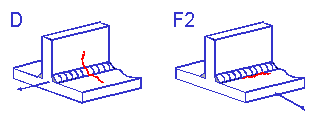
It is then assumed that any complex weld geometry can be described by one of the standard classifications.
Material Properties
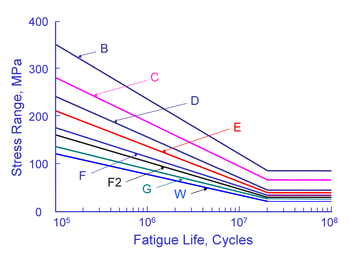
The curves shown above are valid for structural steel welds. Fatigue lives are not dependant on either the material or the applied mean stress. Welds are known to contain small cracks from the welding process. As a result, the majority of the fatigue life is spent in growing these small cracks. Fatigue lives are not dependant on material because all structural steels have about the same crack growth rate. The crack growth rate in aluminum is about ten times faster than steel and aluminum welds have much lower fatigue resistance. Welding produces residual stresses at or near the yield strength of the material. The as welded condition results in the worst possible residual or mean stress and an external mean stress will not increase the weld toe stresses because of plastic deformation. Fatigue lives are computed from a simple power function.

The constant C is the intercept at 1 cycle and is tabulated in the standard. This constant is much larger than the ultimate strength of the material.
The standard is only valid for fatigue lives in excess of 105 cycles and limits the stress to 80% of the yield strength. Experience has shown that the SN curves provide reasonable estimates for higher stress levels and shorter lives. In eFatigue, the maximum stress range permitted is limited by the ultimate strength of the material for all weld classes.
Design Criteria
Test data for welded members has considerable scatter as shown below for butt and fillet welds.
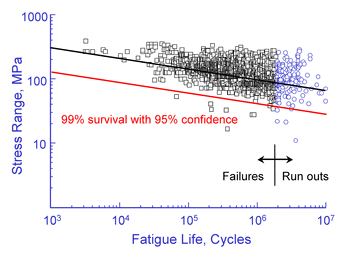
Some of this scatter is reduced with the classification system that accounts for differences between the various joint details. The standard give the standard deviation of the various weld classification SN curves.
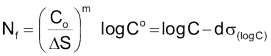
The design criteria d is used to determine the probability of failure and is the number of standard deviations away from the mean. For example d = 2 corresponds to a 2.3% probability of failure and d = 3 corresponds to a probability of failure of 0.14%.
Copyright © 2026 Fast Radiant Portal